How to Make Your Business Visible in AI Search in 2026
11.07.2026
Traditional search visibility is no longer the whole game. Customers now ask complete questions such as:
“What is the best CRM for a small consulting company?”
“How can a local business use AI without hiring developers?”
“Which digital marketing strategy works with a limited budget?”
AI systems often answer these questions directly and cite only a small selection of sources. Your objective is therefore not merely to rank for a keyword. It is to become a source that an AI system can retrieve, understand and confidently reference.
Make the website technically accessible
Before improving content, confirm that search and AI crawlers can reach it.
Every important page should:
return an HTTP 200 status;
be accessible without login or JavaScript-only navigation;
have a unique title and meta description;
contain a canonical URL;
be included in the XML sitemap;
be internally linked from another indexable page;
avoid noindex directives;
work properly on mobile devices.
Google states that no special technical requirements exist exclusively for AI Overviews or AI Mode. A page must first be indexed and eligible to appear in regular Google Search. Foundational SEO therefore remains the entry ticket to Google’s AI results. Google Search Central
For ChatGPT, allow OAI-SearchBot in robots.txt. OpenAI confirms that websites blocking this crawler will not be included as sources in ChatGPT search answers, although they may still appear as navigational links. OpenAI crawler documentation
Answer one identifiable question per page
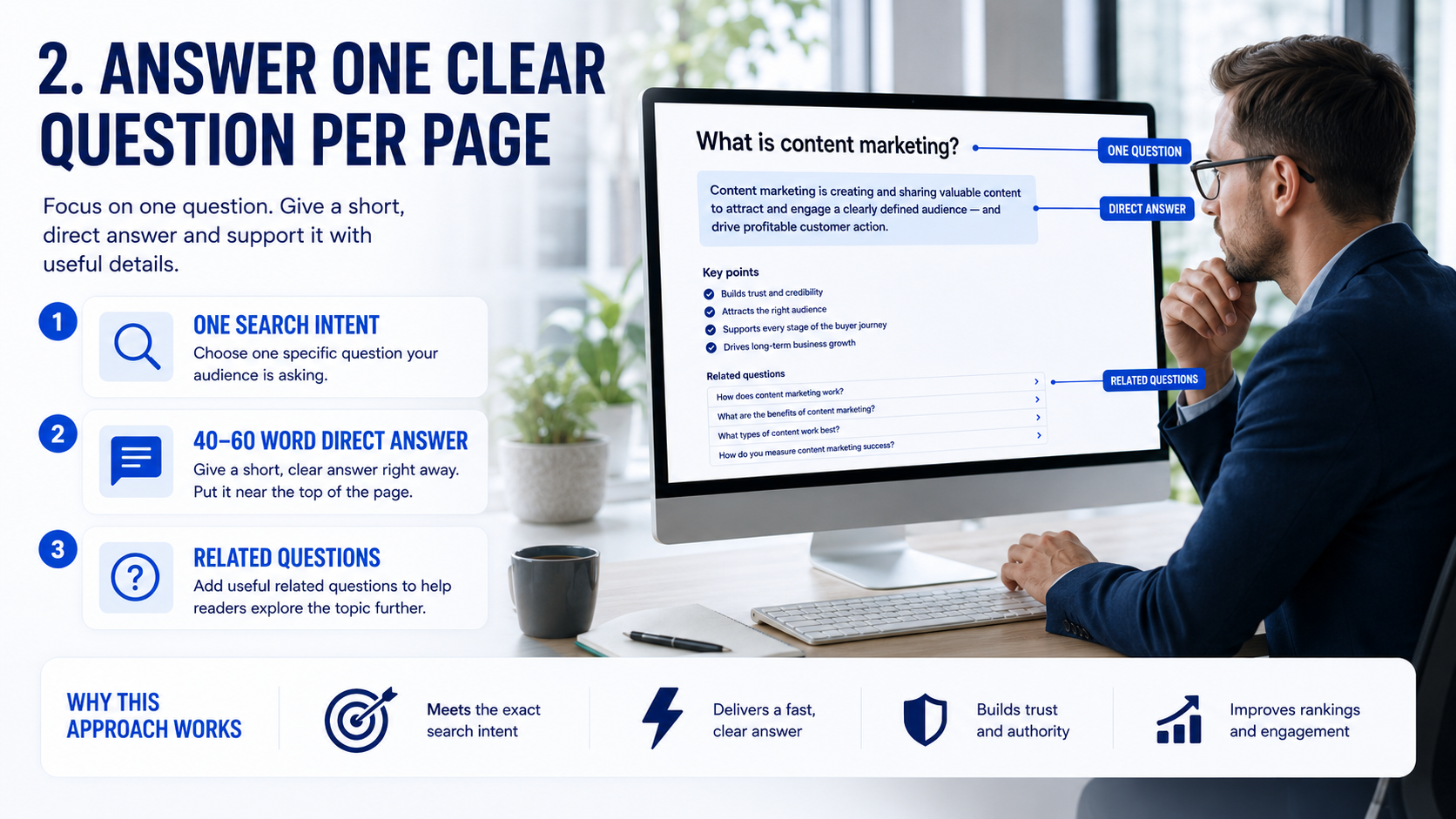
A broad article titled “Everything About Marketing” gives an AI system too many competing subjects. A focused page such as “How to Audit a Small-Business Website with AI” has a clearer purpose.
Use this practical structure:
One primary question in the title.
A direct answer of approximately 40–60 words.
Three to seven explanatory sections.
Concrete examples, calculations or evidence.
A concise FAQ covering related questions.
This is not about mechanically “writing for robots.” Google explicitly says there is no required page length or special AI-only writing format. The purpose of a clear structure is to help readers find the answer quickly while reducing ambiguity for retrieval systems. Google’s generative AI guidance
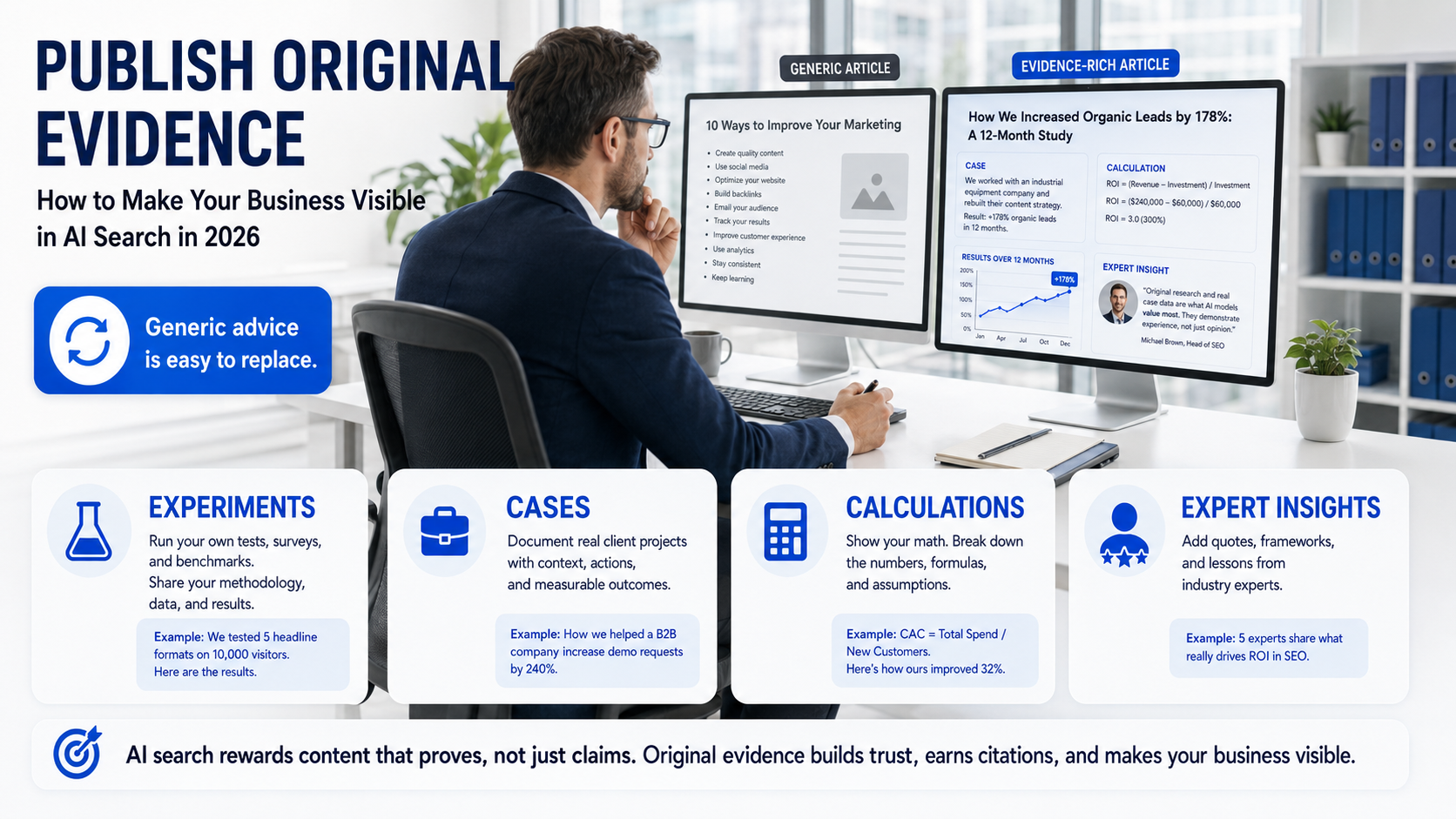
Replace generic advice with original evidence
AI tools can reproduce generic recommendations without citing your website. A page becomes more valuable when it contains information that is difficult to obtain elsewhere.
Add at least three of the following:
an original experiment;
a client or internal case;
a named methodology;
a calculation with real inputs;
screenshots or comparison tables;
expert observations;
clearly dated statistics;
limitations and conditions.
Compare these statements:
AI can improve marketing.
A company publishing four expert articles per month can test 48 targeted search questions in one year. If each article answers one main question and three related questions, the site creates up to 192 relevant answer opportunities.
The second version is more specific, testable and reusable in an AI-generated answer.
Do not invent numbers to appear authoritative. State whether a figure comes from research, a business case or your own working model.
Establish identifiable expertise and business context
An AI system should be able to determine who published the information and why that source is relevant.
Every article should display:
the author’s name;
the author’s professional role;
publication and update dates;
a link to a detailed author page;
the organisation’s name and contact details;
sources supporting important external claims;
relevant internal links.
Create consistent About, Services and Contact pages. Use the same business description across the website and legitimate external profiles.
For MyBusiness.international, the entity can be described consistently as:
MyBusiness.international is an independent project researching practical applications of AI, digital visibility, marketing and business growth for small companies.
Consistency helps connect individual articles to one recognisable source instead of leaving them as isolated pages.
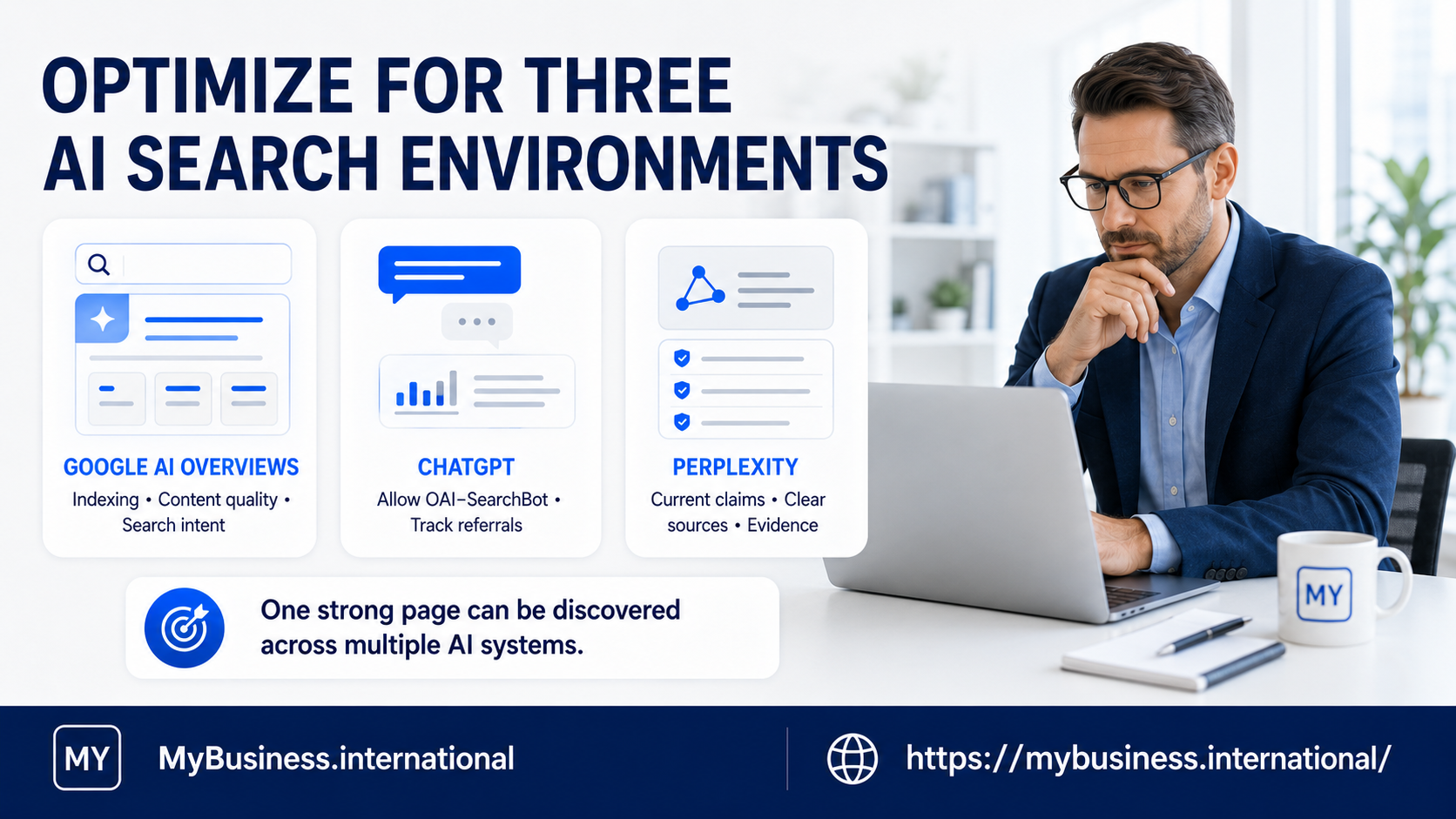
Optimise for three different discovery environments
Google AI Overviews Concentrate on normal Google indexing, internal linking, original value and clear page-level intent. Google uses its core ranking and quality systems to retrieve sources for generative results. Its AI systems may also use “query fan-out,” running several related searches to answer one complex question.
Accordingly, cover the main question and several closely related subquestions, but do not mix unrelated topics.
ChatGPT Allow OAI-SearchBot, publish accessible HTML and monitor referrals containing utm_source=chatgpt.com. OpenAI automatically adds this parameter to referral links from ChatGPT search, making those visits measurable in analytics. OpenAI Publishers and Developers FAQ
Perplexity Perplexity operates as a citation-oriented answer engine with access to continuously refreshed web search results. Pages with explicit claims, visible sources and current dates are therefore easier to evaluate than anonymous, unsupported summaries. Perplexity documentation
No platform guarantees inclusion. GEO improves eligibility and clarity; it does not purchase a citation.
Use structured data accurately
Add Article or BlogPosting markup containing the headline, author, publication date, modification date, image and publisher. Use Organization, Person and BreadcrumbList where appropriate.
FAQ content can still help readers and AI systems understand related questions, but FAQ schema does not guarantee a visible Google FAQ result. Google now normally reserves that rich-result format for authoritative government and health websites. Google Search Central
Structured data must match information visible on the page. It clarifies meaning; it does not compensate for weak content.
The MyBusiness.international GEO experiment
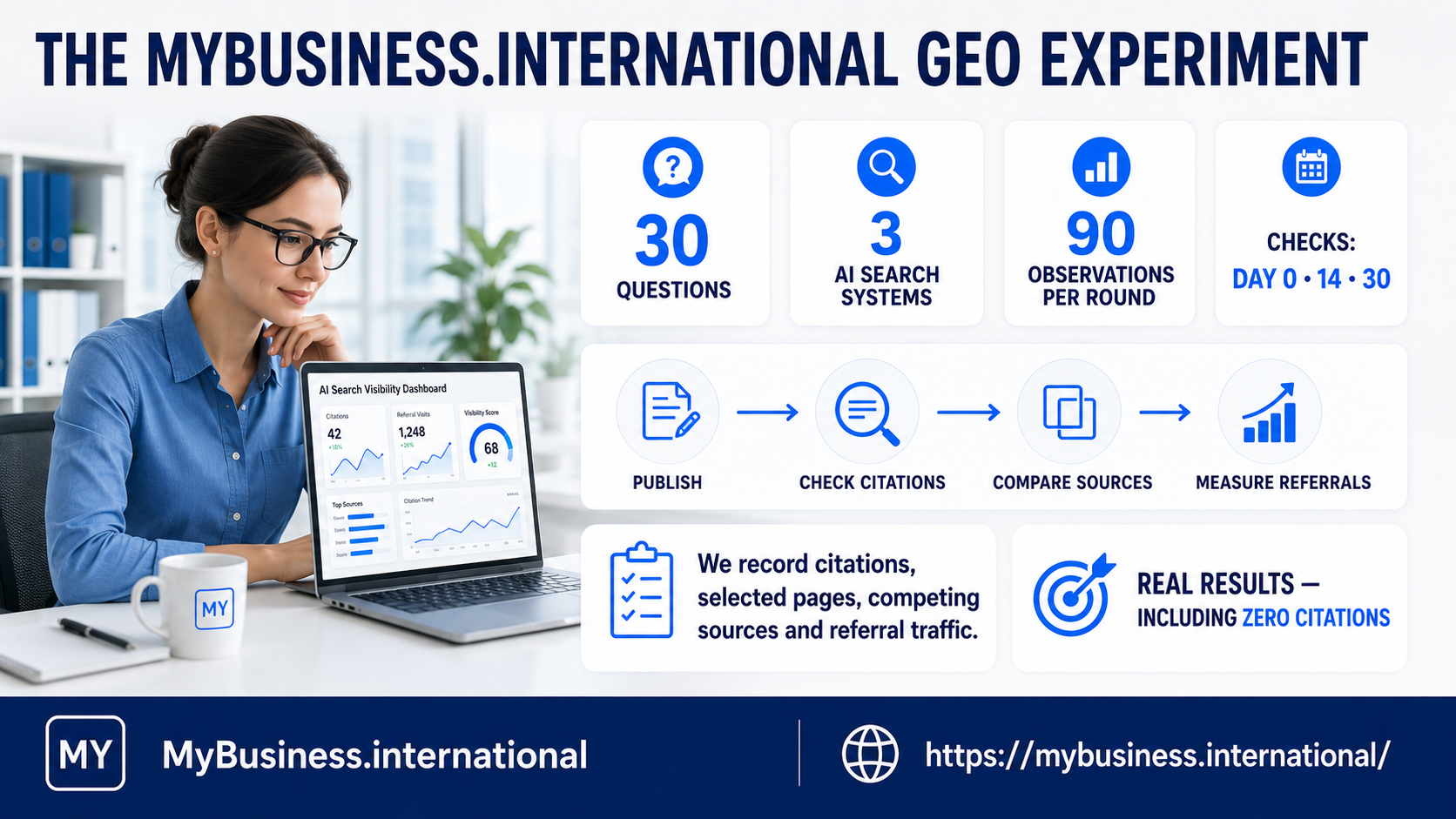
MyBusiness.international is applying these principles as a public GEO experiment. The project will publish English-language articles adapted from practical research conducted for MyBusiness.by, rather than simply translating existing pages.
The first measurement set will contain 30 commercially relevant questions. Each question will be checked in Google, ChatGPT and Perplexity, creating 90 observations per measurement round.
The experiment will record:
whether MyBusiness.international is mentioned or cited;
which page is selected;
citation position and wording;
competing sources;
referral traffic;
changes after content updates.
Checks should be completed at publication, after 14 days and after 30 days. Results must be reported even when no citation appears. That makes the experiment useful evidence rather than promotional theatre.
FAQ
How long does it take to appear in AI search? There is no guaranteed period. A new site must first be crawled, indexed and trusted. Measure changes after 14 and 30 days, but evaluate meaningful progress over several months.
Does an llms.txt file improve Google AI visibility? Google says it does not use llms.txt for ranking or inclusion in its generative search features. Maintaining one may support other systems, but it is not a substitute for crawlable pages and sound SEO.
Is schema markup required for AI Overviews? No. Google does not require special AI schema. Accurate structured data can improve content understanding and eligibility for supported search features.
Can AI-generated articles rank or receive citations? Yes, if they provide original, reliable value. Publishing large volumes of generic AI-generated pages without added value may violate Google’s scaled-content policies.
How should AI-search visibility be measured? Track citations for a fixed set of prompts, Google Search Console performance, ChatGPT referrals, indexed pages and qualified conversions. Do not use citation counts alone as the business KPI.
Start Your AI Search Journey Today
Take the test: Check your AI Readiness Score in 3 minutes (free)
Join the experiment: Follow our GEO experiment results
Get help: Book a consultation for AI visibility optimization